

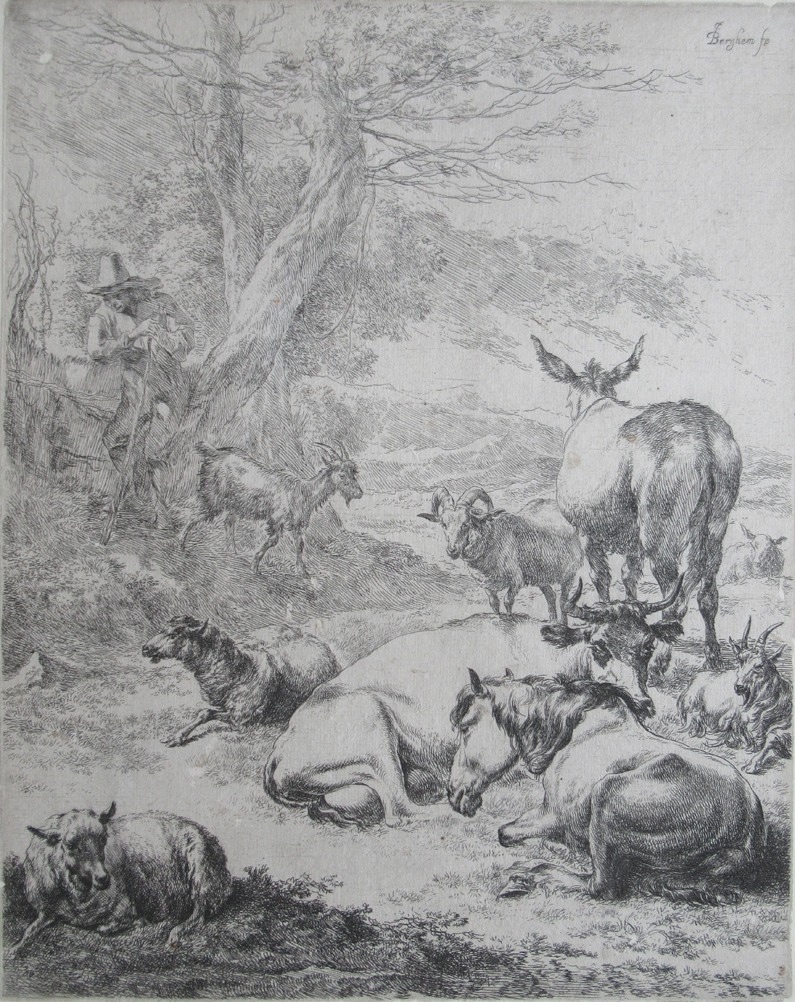
Nicolaes Berchem (1620-1683) – Resting Herd c1652
etching – trimmed to platemark 26.6 x 21.2 cm
Unframed – Price : £200
‘Berghem fe’ top right ‘3’ bottom left corner
Reference: Hollstein 10 Bartsch v.260.10 Weigel 1843-297-10 Dutuit 1881-5.1.36.10
Condition: Good impression in overall good condition. Anomalies – has small holes in parts including on top left, on rear of ass, on right edge, near goat – though these do not detract from image. Nicks on edge of paper lower left and top right outside of image. Laid on conservation Washi paper as support.
Born in Haarlem Nicolaes Berchem (1621/22-1683) had various teachers including his father Pieter Claesz (1597/8-1660), Jan van Goyen (1596-1656), Claes Moeyaert (1592/3-1655), among others. He was one of the most prolific artists of the Dutch Italianates and he made a little over fifty etchings. He was one of the most popular artists also, his work much admired until well into the nineteenth century, and appealed to France’s Rococo circles. It is unclear if he travelled to Italy as there is no documentary evidence to support such a journey, only circumstantial evidence and a recognition that there was a change in his palette and an addition of a sparkling Italian light in his paintings executed after 1653. He resided in Haarlem until he moved to Amsterdam in 1677 where he died in 1683.
Berchem’s etchings are all pastoral subjects dealing with herders and the animals in their charge. His focus on, and the prominence of, domestic animals may well have been initiated while studying with Claes Moeyaert who favoured pastoral subjects. However, one cannot rule out the possible influence of Paulus Potter.
The etching is from a set of five prints showing animals. It shows a typical view of a herder and combination of horses, cows, sheep and goats. The strong sunlight is described via the reflected light off the animals’ hides and the deep shadow on the underside of the herder’s hat. The organisation of the way the animals lie and stand creates the diagonals which lead the eye into the picture. Berchem softens his scenes using a mix of broken strokes and crisscrossing lines with a degree of stipple that infuse the etchings with their southern light. Long distance background views are not given much licence here, Berchem’s entire focus being on the animal and herder group. That he chose to use a vertical format here also narrows the point of view.
Also known as Nicolaes Pietersz Berchem; Nicolaes Berchen; Niclas Berghem; Claes Berighem; Nicolaes Pietersz Berrighem; Nicolaes Berghem