

Jacob Ernst Marcus – Set of Three Landscapes:
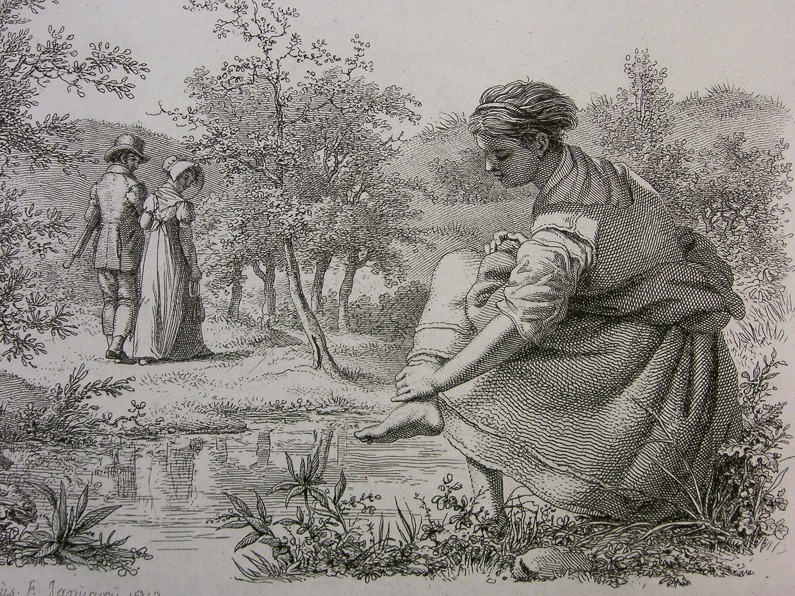
1 – Landscape with Woman Washing her Feet 1813
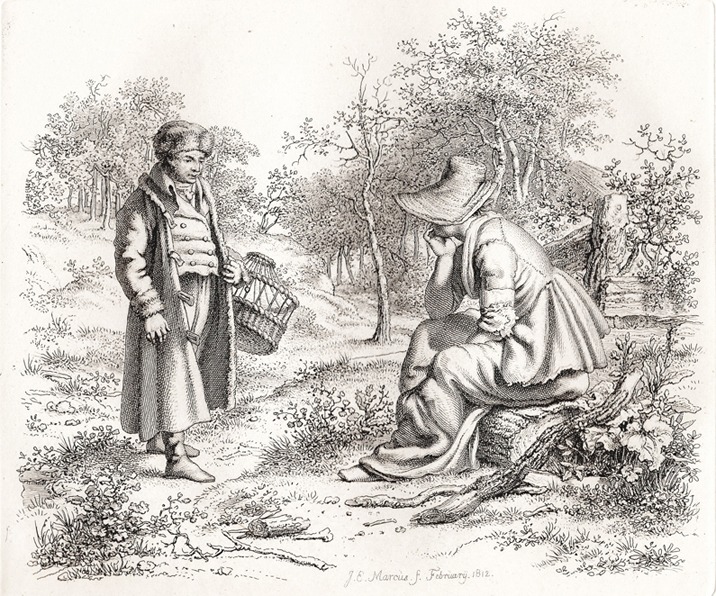
2 – Wooded landscape with woman and man talking, on the roadside 1812
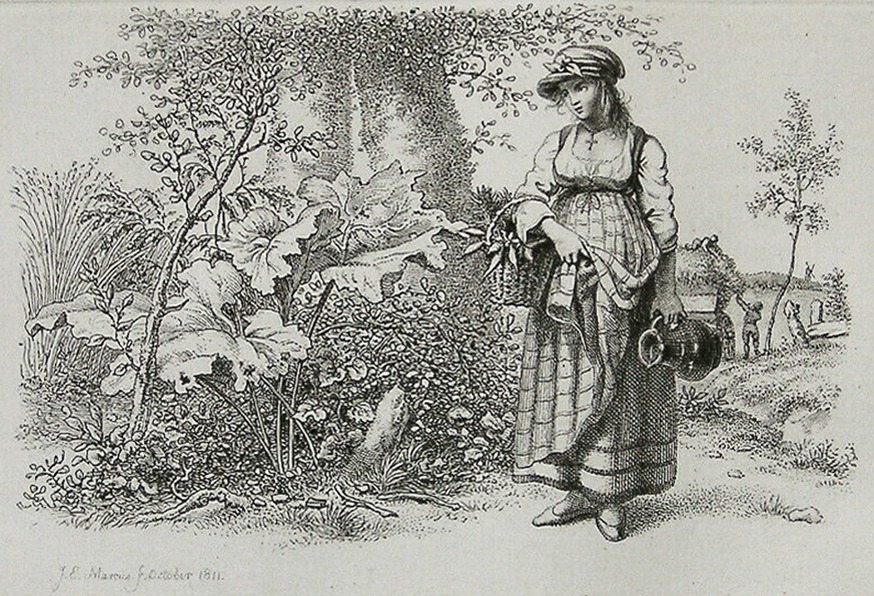
3 – Girl with basket and jug on a country road 1811
etching
Unframed – Sold as set of 3 : £120
Sizes: 1 – image 12 x 18.6 / sheet 23.8 x 32.8 cm
2 – image 16.7 x 19.6 / sheet 22.8 x 32.4 cm
3 – image 11.6 x 17.6 / sheet 23 x 32.6 cm
All from ‘Het Studie-Prentwerk van Jacob Ernst Marcus’ of 1811. These taken from 1834 edition published by S de Grebber. All signed and dated in the plate.
Reference: 1) Korthals 68 2) Korthals 59 3) Korthals 55
Condition: All very good impressions with wide margins. Sheets clean with no faults.
Born in 1774 on the Caribbean island of Sint Eustatius (also known as Statia), part of the islands of the Dutch Antilles, Jacob Marcus settled with his father in Amsterdam in 1783. When his father died a year later, Marcus was brought up by a guardian, the merchant Balthazar Ortt. He received training in drawing from the artist Steven Goblé and in engraving from the well-known printmaker and draughtsman Reinier Vinkeles – one of the few pupils Vinkeles accepted – while also studying at the Stadtstekenacademie in Amsterdam, where he won a gold medal in 1798. Active primarily as a draughtsman and printmaker, Marcus produced landscapes, genre scenes and portraits, as well as reproductive etchings, engravings and lithographs after the work of such earlier artists as Jacob Cats and Jan Steen, among others. A member of the Koninklijke Academie in Amsterdam, Marcus was also a founder member of the Amsterdam Art Society (the Amsterdams Kunstgenootschap) in 1801. Between 1807 and 1816 he published a series of 106 prints under the title Studiebeelden en Fragmenten, and in 1820 was appointed a professor and director of the Akademie van Beeldende Kunsten in Amsterdam. The artist died six years later, in1826, at the age of fifty-two.
Marcus belonged to a generation of artists who sometimes made surprising and refreshing work but were simultaneously quite conventional. His subjects were often taken from everyday life. Marcus converted a number of his subtly observed figure studies into prints, which he collected in the so-called Studieprentwerk. This collection of prints, which also included a group of portraits of fellow artists, enjoyed a certain popularity as a drawing example for other artists. In his landscapes and topographical drawings, Marcus also sometimes succeeded in presenting an unadorned image of nature, in which he withdrew from the conventions of the work of many of his colleagues. It is that ‘fresh look’ that still makes Marcus an attractive artist. In 1972 his work was shown at an exhibition in Curaçao, Aruba and Amsterdam.