
JOHN CLERK OF ELDIN 1728 - 1812
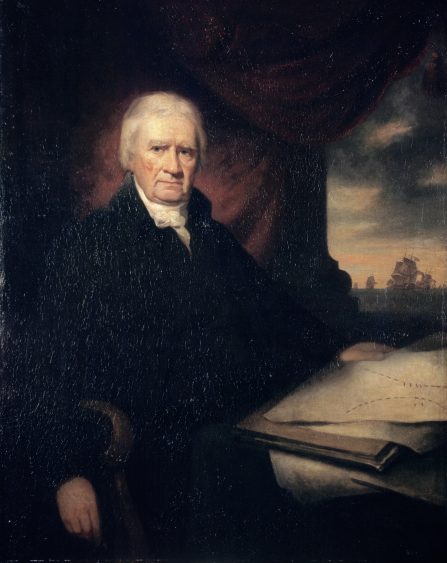
James Saxon ‘John Clerk of Eldin’ 1805
National Galleries of Scotland collection. Photo, National Galleries of Scotland.
The Life of John Clerk of Eldin
“In December this year it pleased God to give my family another increase by the birth of a son, who was christened John after my deceased son”.1
John Clerk of Eldin was born on 10 December 1728, the seventh son of Sir John Clerk of Penicuik and his wife Janet Inglis. The young John Clerk inherited much of his father’s thirst for knowledge. Educated at Dalkeith Grammar School, where John Leslie, regarded as one of Scotland’s most able teachers, was head master, he was an industrious student as Leslie’s report of 6 December 1738 indicates:
“My Lord,
….. I can with pleasure assure you for ought I can give so about John, you’ll ration every farthing bestowed on his education well lay’d out, for if he lives with fair play and due care be taken of him, he’ll turn out among the best scholars in the family …..”2
Unlike his father, John Clerk never travelled abroad to complete his education3 but matriculated at Edinburgh University where he is found in the 1745 class lists of Alexander Munro, primus, professor of anatomy and the man who properly established the University’s Medical School.4 His father had him marked for the medical profession, stating that he would “….prove a top chyrurgeon as his Masters Drummond and Campbell think“,5 encouraging his son to study well and develop good manners, to “cultivate an inviolable honesty in all your dealings for if man who is once caught in a dishonourable thing will have the face of a liar, never again to be either trusted or believed”.6
Drawing was something that the young John Clerk learned at an early age. His father regarded it as an essential skill, mainly for military use (though Clerk never joined the military). Clerk turned out to have a natural talent for drawing and, with assistance from Sandby, became better than most in his family. His subjects focused on landscapes usually containing historic buildings and so are mainly topographical in manner.
However, at the age of about twenty, Clerk appears to have had more of an inclination towards the other sciences; “…. John is the chief operator here [Penicuik House] in Electrical Experiments. He has turned an old worset wheel to an engine and has got a large globe from some of the chymists; but tho his machine be clumsy, yet he performs all the experiments on it, and his mother and systers are to be electrified one of these days by a solemn invitation“.7
As it turned out Clerk did not enter the medical profession. Instead, following in the footsteps of his great grandfather, he became a merchant, running his business in the Luckenbooths,8 a part of the old High Street in Edinburgh, in partnership with one Alexander Scott. He is recorded in the lists of the Company of Merchants as becoming “Burgess and Gild brother in this city in right of Sir John Clerk, his father….” on 17 July 1751.9 Clerk was a clothier since the Company of Merchants described itself as “….sellers of cloths, stuffs or other merchandise for the apparel and wear of men and women….” A letter of 21 September 1756 from his sister Janet Carmichael requested him to provide a new coat for her friend Richard Smith on her account,10 while he wrote to his father: “I have at last got your hat that was ordered. If you find any fault with it you may return it again….” 11 Burgess tickets reveal John Clerk trading as far from Edinburgh as Campbeltown, Argyll (received 1769) and Montrose, Aberdeenshire (1771).12 He continued as a Guild merchant until 1762.
While working in Edinburgh, Clerk came to be associated closely with the city’s social circles. An important meeting place was the house of the Adam family in the Cowgate where Clerk was a constant visitor. The Clerk family had long been associated with the Adam family, through Sir John’s patronage of William Adam, leading builder, architect and principal mason to the Board of Ordnance of North Britain (appointed 1730). Adam became a close friend to Sir John and accompanied him on a journey to London in 1727, a trip which took in visits to country seats that included Clivedon, Wilton and Wanstead Park.13 Besides making improvements at Penicuik House, Adam had assisted Sir John in the building of one of Scotland’s loveliest classical houses Mavisbank in 1723, situated near Loanhead.14 It is very likely that Adam was the builder commissioned by Sir John Clerk to build houses for his miners at Loanhead in 1736.
Members of the Clerk family regularly visited the Adams and John (of Eldin) was later to write: “the numerous family of Mr. Adam, the uninterrupted cordiality in which they lived, their conciliating manners and the various accomplishments in which they severally made proficience, formed a most attractive society, and failed not to draw around them a set of men whose learning and genius have since done honour to that country that gave them birth”.15
John Clerk of Eldin became a close friend to Robert Adam (1728-1792), a man of his own age. Both men studied anatomy at Edinburgh University (Robert is also listed as a student under Professor Munro). In 1753, Clerk brought the families closer together by marrying Susanna Adam, Robert’s younger sister.16 Even after Robert and his elder brother James had established their architecture practice in London in 1758 the two families maintained a constant correspondence, the letters full of pleasantries and snippets of gossip.
John and Susanna’s first child Mary was born in 1754. Their first son, John, was born in 1757.17 In all they had seven children, three sons and four daughters, their last, James born in 1773.18 It is evident that John Clerk was very much a family man, both within his own home and with his siblings. He gave financial support to his sister Johanna to the sum of £20 annually from 1773.19 From the large amount of correspondence to and from Robert Adam’s sister Margaret (whom he addresses as Meg or Maggie), one gleans much about his family life and business fortunes.20 Furthermore they reveal something of his personality. In some letters he included light hearted ditties, comprising a collection he titled ‘Songs of Eldin’ which he ruefully described in 1775 as having been held “in contempt by Susie and the bairns”, reflecting the good humour and caprice later remarked upon by Lord Cockburn.21 He often addressed affectionately his letters to Susanna as dear ‘Wiffie’.
In 1763, having amassed a little money, Clerk bought an estate near Lasswade, adjoining the Pendreich coalfields in which he had taken a half share in the previous year with his business colleague Alexander Scott.22 On this estate “he built his little mansion of Eldin, laid out its beautiful terrace and its singular garden, converted an old cottage into a greenhouse, which was more ornamented with his beautiful clay models than with plants”.23 The name Eldin derives from the old Scots word elding or eilding meaning fuel, in accord with his involvement with coal mining. He was able to add to the estate in 1775, extending the garden with the acquisition of additional ground from his neighbour, Lord Dundas.24
Purchasing the Pendreich coalmines was distinctly in line with the family business. The Clerk family were extensive landowners (from Berwickshire to Lanarkshire) and coal mine operators in the vicinity. His father had written a Dissertation on coal and coal works in 174025 (which he had presented to the Philosophical Society of Edinburgh), and was dedicated to the improvement of the productivity and safety of mining. Clerk of Eldin continued his father’s ambitions in these regards. In future years he was often consulted by other coal operators and owners as an expert, advising on various aspects of the industry, from remarking on the quality of coal to the legal rights of access to mining it.26
Clerk took as great an interest in the byproducts of coal as in its use as a fuel. As a shareholder in the Carron Company, an ironworks near Falkirk that had started operating in 1759, he was able to experiment. With the foundry opting to use coke rather than charcoal for its furnaces, Clerk developed new and improved pitch sealants for use on the underside of ships from the coal tar residue from the foundry’s manufacture of the coke.27 By application of heat tar is separated into several materials, one of which is pitch. “There is lately discovered in this country an art of extracting Pitch and Tar from Coal. Mr John Clark [sic] has brought it to such perfection that a ship has gone to sea payd with it, and the merchants and carpenters much pleased with it. The Residium after extracting the pitch by distillation is charcoal for iron works, and more valuable than the coal that was thrown into the vessel. So that the Pitch is all clear profit.” 28
Many renowned people with whom Clerk was connected were associated with the Carron works. James Adam, Robert’s brother, did work for the foundry and the two brothers were to have their fireplaces and balustrades made there. John Smeaton, the ‘father’ of civil engineering, was engineering consultant and designed many of the machines used at the works.29
Besides coal, Clerk of Eldin took an interest in lead mining, another part of the Clerk family business portfolio. A watercolour drawing by him from c.1775 in the collection of Dumfries Museum shows the lead mines at Wanlockhead in Dumfriesshire. These mines were owned by the Duke of Buccleuch and Queensberry and lie adjacent to mines at Blackcraig by Leadhills in Lanarkshire that the Clerk family had considered purchasing in 1782.30
Throughout the following years, Clerk’s business interests in new scientific and engineering projects reached far and wide. One finds him involved as a shareholder in the construction of the Forth and Clyde Canal, a major national project that started in 1768 but which ran into financial trouble a decade later. In 1767 a public company was formed with 1500 shares subscribed by the most powerful and intellectual figures in Scotland including six dukes and seventeen earls. Construction of the canal started from the Firth of Forth at the River Carron, transforming Falkirk from a market town to a centre of industry.31
As with so many other projects going on at this time, one finds many of the same people involved. William Adam had been a strong supporter and had done some of the earliest surveys for the project in the early part of the century. James Hutton, a good friend of Clerk of Eldin whom he had met at University, was involved with the canal between 1767 and 1774 as a geology surveyor. Hutton made extensive site inspections during the period of construction and acted as both a shareholder and as a member of the management committee. John Smeaton was the designer and builder of the canal. Indeed Clerk’s associations with Smeaton helps to explain why he, Clerk, on his journey to the South of England in 1772 travelled the not inconsiderable distance to Plymouth in order to draw the Eddystone Lighthouse (etching B89) which Smeaton had designed and built between 1755 and 1759. Clerk also etched Smeaton’s bridge at Perth (completed in 1771) in 1775 (B65).32
Clerk’s journey illustrates his great passion for innovation; on an earlier trip to Wales in 1766 he had visited William Edwards noted bridge over the river Taff at Pontyprydd, completed after four attempts in 1756 and for over forty years the largest single arch bridge in the country, being 140 feet (43m) in span. Clerk etched this bridge in 1776 (B64).
From the Clerk of Penicuik archive one can see the breadth of Clerk’s interests: a 1781 memo regarding the Indian method of manufacturing and dying cotton; a letter of 1788 in which he complains that his ideas on the improving of Leith harbour have been hijacked; a proposal of 7 April 1790 from David Steuart Erskine, 11th Earl of Buchan, on the establishment of a wool mill on their lands to undercut “our neighbours in the South with cloths of equal quality” (though there is no record to confirm Clerk’s involvement with any such project); correspondence with Sir Charles Middleton of the Admiralty from 1787 on the best method of raising the sunken HMS Royal George; his advice to William Adam for building new warehouses and docks on the Isle of Dogs, London; and his ideas for new mining engines and making thermometers.33
Throughout the mid 1770s Clerk of Eldin’s business suffered mixed fortunes, due in part to dubious activities of his coal grieve (manager) James Moffat who in one year earned him just £6034 as opposed to the hundreds which was the mine’s potential. Clerk mentions “… a series of awkward accidents and circumstances with respect to the managing servants of my coal lines which has thrown such a load of writing and calculations on my own shoulders that the slavery I own is undergoing greater than can be put into words”.35 In April 1769, a reasonable year, he had received £99 19s 1/2d from the mine and a further £98 8s36 income from the Carron Ironworks. A few years later, this level of income was not forthcoming. His etchings brought a little money into the household, although not an appreciable amount. As a consequence, he started to look for other opportunities, leading to his application and eventual securement of the post of Secretary to the Board of the Annexed Estates in Scotland in 1783.37 Regrettably this lasted only one year as the Board was disbanded in 1784. In further years he tried to attain, without success, other positions such as the Comptrollership of the Port of Leith.38
Further to making his etchings, the 1770s was a busy decade for Clerk. Clerk claims to have started to turn his attention in a different direction around 1770, to the problem of Britain’s failure to win any effective naval battles. In this respect he was participating in a long standing naval tradition within the Clerk family. Several members had been lost at sea, through battle or illness, but family pressure did not allow Clerk to enlist, much to his regret. Nonetheless he was strongly patriotic. His treatise An Essay on Naval Tactics was written in 1781, encouraged by the defeat of the British fleet by the French in the West Indies during September of that year. After 1776, the year of independence for the American colonies, Britain was still involved with struggles against the French, and Spanish, one time allies to the American cause. The Essay was intended as Clerk’s contribution to the Wars. The principal tactic Clerk describes is of bisecting the enemy’s line, a plan that ran counter to traditional strategy of aligning the fleets opposite each other.
The book was well received when privately published in 1782,39 its distribution being primarily amongst friends and the admiralty.40 In the same year, Admiral Rodney heavily defeated the French at the Battle of the Saints off Martinique, where similar tactics to those advocated by Clerk were used. Even though Rodney is reputed to have known Clerk’s book, there has always been some debate surrounding the extent of Clerk’s influence on this engagement. However, as Lord Cockburn was later to write, “It is possible that the same thought may have occurred to other men at the same time; but my conviction of the honesty of Clerk is so complete that I am certain he would have disdained to claim a discovery he had not made”.41 The first public editions contained plates engraved by Andrew Bell.
With his creation of a new pitch for the underside of ships and in turning his mind to naval tactics, it is obvious that the sea and ships were important to him, the interest coming from an early age. In an introduction to the early edition of An Essay on Naval Tactics Clerk writes: “I had acquired a strong passion for nautical information when almost an infant. At ten years old, before I had seen a ship, or even the sea but at a distance of four or five miles, I formed an acquaintance at school with some boys who had come from a distant seaport, and who instructed me respecting the different parts of a ship from a model which they had procured. After this apprenticeship, I had frequent opportunities of seeing and examining ships at the neighbouring port of Leith, which increased my passion for the subject; ….“42 Perhaps not surprisingly, one finds that his father was shareholder in several of these ships.43 And in his etchings Clerk placed skiffs and ships in the scenes as often as the opportunities arose.
In the years following the completion of An Essay on Naval Tactics, Clerk undertook several journeys with his geologist friend Dr James Hutton, travelling to Tilt (1785), Galloway (1786), Jedburgh (1787) and Arran (1788) on a project for which he is equally renowned. Hutton was in the process of radically rethinking traditional concepts of geological time and age, 44 the principal theories about which he had evolved in the 1760s and 1770s. He communicated his ideas to very few people, “…to none but his friends Dr Black and Mr Clerk of Eldin”.45 The drawings that Clerk executed in these journeys around Scotland were intended specifically for the last volumes of Hutton’s seminal four part publication, Theory of the Earth. The first two parts were published in 1795 while last two volumes, that were intended to contain Clerk’s illustrations, were not ready for publication before Hutton’s death in 1797. The drawings probably never left Clerk of Eldin’s hands. They disappeared from sight for nearly one hundred and seventy years, eventually rediscovered in 1968 in the Clerk of Penicuik archive.46 The drawings are surprisingly accurate in their technical detail, and beautifully executed in pencil, pen and various types of wash. They have a delicacy and clarity which is hardly seen in his picturesque drawings, understandable considering they were to be engraved. They reveal a deep understanding of Hutton’s theories. In tribute to Clerk’s work, seeing as “….. Mr Clerk’s pencil was ever at the command of his friend, and has certainly rendered him most essential service”,47 Hutton dedicated the first copy of the Theory of the Earth “to Mr Clerk of Eldin, from his most affectionate friend and fellow traveler (sic), Dr James Hutton”.
Clerk divided his time between Eldin and Edinburgh, taking a missive tack (lease) in January 1784 on a house on the corner of Hanover Street at £40 per annum.48 Edinburgh during the latter half of the eighteenth century was a city in which people advocated new concepts on any subject, meeting in clubs to discuss and exchange ideas. In 1776 Clerk is cited as one of 43 members of the Poker Club, a frugal and moderate establishment where gentlemen lunched and relaxed.49 According to Dr Carlyle the club consisted of all the literati of Edinburgh and its surroundings, where “….the dinner was set soon after two o’clock, at one shilling a head, the wine to be confined to sherry and claret, and the reckoning to be called at six o’clock,”.50 David Hume said of the Poker Club “I dine, I play a game of backgammon, I converse, and am merry with my friends; and when after three or four hours amusement, I return to these speculations, they appear cold, and strain’d, and ridiculous, that I cannot find it in my heart to enter into them any farther.”51
It should be remarked that often members of one society and/or club were the same as found in others. Clerk was a member of the Royal Highland Society, and of the Oyster Club where James Hutton was one of the three original members. Besides Clerk and Hutton, eminent members of the Oyster Club include David Hume, Adam Smith, John Home, Dr Joseph Black, Sir John Dalrymple, Dr Ferguson, and Dr William Robertson. In addition, Clerk was a founding member of both the Society of Antiquaries of Scotland (1780), established by David Steuart Erskine, 11th Earl of Buchan, and the Royal Society of Edinburgh (1783) with many of the same personages. In his Memoirs, Lord Cockburn stated that Clerk was “….looked up to by all the philosophers of his day, who received hints and views from him which they deemed of great value”. 52
By 1793, Clerk had retired from the coal trade, but still travelled between Eldin and Edinburgh. He had bought a house on Princes Street in 1788, number 70, overlooking the castle “…. where it is most precipitous and …. in appearance equable to anything that can be seen the Highlands ….”,53 and was known often to visit his son John at his house at 16 Picardy Place.
Susanna died on 13 April 1808. Clerk lived for a further four years, dying at Eldin on 10 May 1812, surrounded by his family. He was buried in an unmarked family vault in the north transept of the Old Church of Lasswade.
Lord Cockburn described Clerk as “an interesting and delightful old man, full of the peculiarities that distinguished the whole family – talent, caprice, obstinacy, work, kindness and oddity”.54 John Playfair concurred: “He possessed a strong and inventive mind, to which the love of knowledge and the pleasure derived from the acquisition of it, were always sufficient motives for application. He had naturally no great respect for authority, or for opinions, either speculative or practical, which rested only on fashion or custom. He never circumscribed his studies, by the circle of things immediately useful to himself; and I may say of him, that he was more guided in his pursuits, by the inclinations and capacities of his own mind, and less by circumstance and situation, than any man I have ever known.”55 “Clerk was a striking looking old gentleman, with grizzly hair, vigorous features and scotch speech. It would be difficult to say whether jokes or disputation pleased him most. I know of no better account of the progress of a father and a son than when I once heard him give of himself and his son, John, in nearly these very words – ‘I remember the time when people seeing John limping on the street [John was born lame], used to ask, What lame lad that was? And the answer would be, That’s the son of Clerk of Eldin. But now, when I myself am passing I hear them saying, What auld grey-headed man is that? And the answer is ‘That’s the father of John Clerk.’ He was much prouder of the last remark than of the first.”56
None of John and Susanna’s children married and all died without issue. John Clerk, Lord Eldin came to be one of the most noted advocates of the day.57 He amassed a huge collection of art, particularly by Italian, Dutch and Flemish Old Masters, and a considerable library. After his death in 1832 the collection was auctioned off in a sale at his house that was scheduled to last a fortnight, but came to be most notably remembered for the main floor collapsing under the press and weight of avid buyers on day three of the sale.58 Eldin House was demolished in mid nineteenth century and replaced by a Victorian mansion, today a care home, Nazareth House, run by the Sisters of Nazareth.59
This biography is the full content of chapter one of The Etchings of John Clerk of Eldin by Geoffrey Bertram. All rights reserved. No extracts to be taken without permission of the author. Contact geoffrey@bertram-arts.com. Quotations and extracts from the Clerk Family archive at National Archives of Scotland courtesy of Sir Robert Clerk.
NOTES
NAS indicates National Archives of Scotland. All Clerk of Penicuik manuscripts in the NAS start with the prefix GD18
1 From Memoirs of the life of Sir John Clerk of Penicuik, Baronet, Baron of the Exchequer, extracted by himself from his own journals, 1676-1755. NAS, Edinburgh; introduction and notes by John Gray. Publications of the Scottish History Society Volume XIII, 1892, Edinburgh University Press p.135, folio 152. John Clerk (1701-1722) was the child of Sir John Clerk and Margaret Stewart, his first wife. He was their only child before her death. Sir John subsequently married Janet Inglis by whom he had 16 children.
2 Letter from John Leslie, headmaster of Dalkeith Grammar School, 6 December 1738. NAS. Clerk of Penicuik MSS GD18/5380.6
3 Sir John Clerk spent five years abroad between 1694 and 1699, staying in Leyden until 1696 before travelling to Italy and returning via Paris.
4 The class lists of Professor Alexander Munro show that Clerk attended there in 1745. The same lists show that James Hutton also attended. University of Edinburgh Library, Dc 5.95.
5 Letter from Sir John Clerk to Mr George Clerk of Drumcrief. NAS GD18/5539.67
6 Advice by Sir John Clerk to his son John when he went to serve his apprenticeship as chirurgeon under Adam Drummond and John Campbell, 23 April 1745. NAS GD18/2331.
7 Letter from the Factor of Penicuik Estate, Adrian, to George Clerk, 19 February 1747. NAS GD18/5396.66.
8 An extinct range of buildings, the name is supposed to have been conferred on the shops in that situation as being ‘close booths’, to distinguish them from the open ones, which lined the great street on both sides, ‘Lucken’ signifying close, therefore implying a certain superiority to the ancient traders in these booths. See Cassell’s Old and New Edinburgh – its history, its people and its places, Volume I.
9 Scottish Record Society, Vol.62, Roll of Edinburgh Burgesses and Guild Brethren 1701- (1760) – 1841. Edit. Charles B. Boogwatson, Edinburgh 1930. The Company of Merchants in their charter of 1681 call themselves “….sellers of cloths, stuffs or other merchandise for the apparel and wear of men and women….” See The Rise and Progress of the Company of Merchants in the City of Edinburgh 1681-1902 by A. Heron. App.1, p.383. It was necessary to acquire a Burges Ticket before one could trade in the borough. It entitled you also to buy seats in church, and be eligible to be elected to the local council.
10 NAS GD18/5488.
11 NAS GD18/5469.3.
12 NAS GD18/2064 and GD18/2067 respectively.
13 Friedman, Terry (1990). ‘Mr Inigo Pilaster and Sir Christopher Cupolo: On the Advantages of Architectural Farrago’. Architectural Heritage I: 33–48.
14 Sir John Clerk of Penicuik Memoirs, op. cit., folio 134, p.115.
15 J. Fleming, Robert Adam and his Circle, London 1962. pp.5-6.
16 NAS GD18/5560 – Contract of marriage.
17 It is this John Clerk who was to take the title Lord Eldin when appointed Ordinary Lord of Session in 1823, a title which has caused much confusion regarding father and son, in both attributions of work and historical events.
18 His son William was a youthful friend of Sir Walter Scott. Following in family tradition, James was in the navy during the 1780s and 1790s.
19 Clerk benefitted from financial arrangements within the family. A document dated 25 February 1758 concerns a bond of provision of £2000 from his brother Sir James Clerk (£163,000 at 2000 value), though it does not indicate why this loan or investment was made. The same document reveals a £150 sum for Susannah. NAS GD18/1988.
20 NAS GD18/4961 includes 83 letters.
21 Lord Cockburn, Memorials of his Time, Edinburgh 1946. Abridged and edited by Forbes Gray, p.164. First published 1856.
22 National Library of Scotland. MS102. Entries for 7 February and 2 October, 1779. See also NAS GD18/5560 for set of purchase papers, and NAS RHP84321 Plan of Coalfield in the Barony of Pittendreich (Pendrick), Property of John Clerk of Eldin.
This estate had originally been part of the larger Pendreich estate. Instruments of sasine suggest that in 1750 it was owned in toto by Lord Ross. The coalworks then went through a change of ownership to the Marquess of Lothian and then to Scott and Clerk. The house estate was sold to a Mr Brown, merchant, in 1752; a Mr Tod in 1758; and then purchased by Clerk.
23 The Rt. Hon. William Adam, Two Short Essays on the Study of History and on general reading, with a preface and a concluding note: The Gift of a Grandfather , Blair Adam, 1836. pp.27-28. There are few references to Clerk’s clay models. Only a few tiny balls of clay with sticks attached as ‘mast’, used as models in working on his naval tactics, have survived in the Clerk family collection.
24 NAS GD18/5756 – correspondence between Clerk and Henry Dundas.
25 NAS GD18/1081.
26 See for example NAS GD18/1129 letter to Clerk from Mrs Clephane regarding his opinion on the coal seams on the Powguild Estate.
27 See NAS GD18/6001 for recipe for tar covering.
28 Sir John Dalrymple (Scottish Judge, 1726-1810) to M.Bolton, Soho, Birmingham, 21 July 1781, 4 pp folio. P36D D1.
29 The story of the foundry can be found at the Falkirk Local History Society web site at www.falkirklocalhistorysociety.co.uk /home/index.php?id=107 Even the American inventor Benjamin Franklin visited the works and is said to have left a design for a stove – ‘Dr Franklin’s Stove or the Philadelphia Stove’.
30 NAS GD18/1179 Letter to George Clerk of Drumcrief [Dumcrieff] from William Newbigging on mining operations at Leadhills.
31 See letter of 14 November 1787 to John Clerk of Eldin giving him news and progress report on the building of the canal. NAS GD18/5869, and other canal affairs in GD18/5862.
32 John Smeaton’s (1724-1792) design for the Eddystone Lighthouse was considered a marvel not only for being radical and innovative for its time (with the lighthouse built of granite blocks secured using dovetail joints and marble dowels) but for his pioneering use of hydraulic lime, a type of concrete that sets under water. Smeaton built several projects in Scotland including Banff and Peterhead harbours (1770-1775) and Aberdeen Bridge (1775-80).
33 See NAS GD18/5940, 5486.17, 5944, 4239, 4984.
34 GD18/5486.6. Letter from Clerk. £60 is the equivalent of about £3,820 in 2005 money. Reference The National Archives currency converter for all subsequent calculations.
35 NAS GD18/5558. Letter from Clerk to Mr Walker, Dublin.
36 About £6,366 and £6,267 in 2005 money respectively.
37 Clerk had a great deal of difficulty in securing this position. See NAS GD18/5486.8 – 11.
38 NAS GD18/5529.1.
39 John Clerk of Eldin, An Essay on Naval Tactics – Systemmatical and Historical with Explanatory Plates, in four parts. First part publicly published in London, 1790; the others in 1797. In the National Archives of Scotland there is an original manuscript, An Inquiry into Naval Tactics, with additions and alterations by the author, with a third printed copy annotated by Admiral Rodney – GD18/4218.
40 A letter to Robert Adam from William Adam states the intention of the Duke of Montagu to present Clerk’s Essay on Naval Tactics to the King. C.1782. NAS GD18/4231.
41 Lord Cockburn, op. cit., pp.163-4. Later, a letter of 10 March 1797 from his daughter Susan states that everyone ascribed the English naval victory over the Spanish at Cape St Vincent (Windward Islands), despite being outgunned and outnumbered by 27 to 15, to the use of his tactics, and reporting praise of his book by Admiral Rodney.
42 John Clerk of Eldin, op. cit, Preface of 1782 edition.
43 NAS GD18/2570.
44 James Hutton (1726-1797) is regarded as one of the founders of modern geological thinking for his concept of geological time being in millions of years and not in thousands as previously thought. See also note 4.
45 John Playfair, ‘Biographical Account of the Late Dr. James Hutton. F.R.S. Edinburgh’, Transactions of the Royal Society of Edinburgh Vol.5, no.iii, 1805, pp.39-99.
46 See James Hutton’s Theory of the Earth: The Lost Drawings. Text by G.Y.Craig, D.B.McIntyre, C.D.Waterston, edited by G.Y.Craig. Scottish Academic Press, 1978.
47 John Playfair, op. cit.
48 NAS GD18/971. About £2,514 in 2005 money.
49 The Poker Club – http://my-bankruptcy-help.com/?b=The_Poker_Club
50 The Poker Club, op cit.
51 The Poker Club, op. cit.
52 Lord Cockburn, op. cit.
53 NAS GD18/5541. Letter from John Clerk to Lord Balgonie. Undated but Lord Balgonie’s letter of reply is dated 24 July 1788.
54 Lord Cockburn, op. cit.
55 John Playfair, ‘Memoir relating to the Naval Tactics of the late John Clerk Esq of Eldin.’ Transactions of the Royal Society of Edinburgh. Vol.9, 1823, chapter 8, p.115.
56 Lord Cockburn, op.cit.
57 One of Lord Eldin’s most high profile cases was as defence lawyer for Deacon Brodie in 1788.
58 Catalogue of the Collection of the late Hon. J. Clerk of Eldin. Edinburgh, March 1833.
59 David Laing remarked in 1855 that the house had been pulled down except for one wing. From his introduction to The Etchings of John Clerk of Eldin, Bannatyne Club 1855.
Selected Bibliography
Bertram, J.G. John Clerk of Eldin, Etchings and Drawings, exhibition catalogue, Edinburgh 1978
Bertram, J.G. The Etchings of John Clerk of Eldin, Enterprise Editions, 2012
Bonehill, J, Dulau Beveridge, A, Leask, N – Editors Old Ways New Road, Travels in Scotland 1720-1832, Birlinn/The Hunterian, 2021
Brown, I.G. The Clerks of Penicuik. Portraits of Taste and Talent, Penicuik House Preservation Trust, Edinburgh 1987
Clerk, J Etchings, Chiefly Views in Scotland, Bannatyne Club, 1825
Clerk, J. An Essay on Naval Tactics – Systematical and Historical, with explanatory plates, in 4 parts, London 1790
Fleming, J. A Retrospective view by John Clerk of Eldin, with some comments on Adam’s Castle Style, Concerning Architecture; Essays presented to Nicholas Pevsner, edited by J. Summerson, London 1968
Gunn, Ann The Prints of Paul Sandby (1731-1809): A Catalogue Raisonné, Brepols, 2016
Hardie, M. Letters from Paul Sandby and John Clerk of Eldin, Print Collectors Quarterly, Volume 20, 1933
Holloway, J. and Errington, L. The Discovery of Scotland, exhibition catalogue, National Galleries of Scotland, Edinburgh 1978
Hopkinson, M. and Smith, W. A Ramble on Copper: Two Centuries of Scottish Etching 1750-1950, exhibition catalogue, The Fleming-Wyfold Art Foundation, London 2003
Lumsden, E. S. The Etchings of John Clerk of Eldin, Catalogue and Description, Print Collectors Quarterly, Volume 12, 1924
Tait, A. A. Robert Adam and John Clerk of Eldin, Master Drawings, Volume IX, number I, pp.53-58, 1978