
JOHN CLERK OF ELDIN ON NAVAL TACTICS
In the preface to the second edition of An Essay on Naval Tactics in 1804, John Clerk explained that his interest in ships was established in his boyhood:
I had acquired a strong passion for nautical affairs when I was almost an infant. At ten years old, before I had seen a ship or even the sea, but at a distance less than four or five miles, I formed an acquaintance at school with some boys who had come from a distant seaport and who instructed me respecting the different parts of a ship from a model they had procured.
This mild beginning does not hint at the impression Clerk was to make on the Admiralty four decades or so later. He first turned his mind to naval tactics following the failure of the Royal Navy to overcome the French at the First Battle of Ushant (Ouessant to the French; it is the most westerly isle off the Brittany coast) in 1778, with the subsequent court-martialling of the English Admirals Keppel and Palliser. This defeat, and those experienced in the following years, showed the Admiralty’s shortcomings at a time when Britain was yet to assume sea supremacy, come the time of Horatio Nelson. Naval engagements usually took place at close quarters, with gunpowder a critical factor. Since 1653, the British Navy’s strategy was to approach the enemy in what is known as the line-of-battle-ahead tactic, in which warships form a single column, allowing the fleet to present their broadsides to an enemy and concentrate their firepower without their guns being obscured by friendly vessels. This was deemed preferable to the usual melees that had taken place before then, as it was intended to prevent vessels from coming together closely to be grappled and boarded. However, the line-ahead worked much better defensively than offensively and often led to indecisive naval actions in which parallel lines of battle blasted away at one another to little effect.
Clerk of Eldin put his mind to solving what he saw as a major problem. His approach was simple and yet radical for its time. In effect, he suggested that British ships attack the enemy from multiple directions to make themselves less predictable. One of his propositions was to break the enemy’s line, to bisect it, separating the enemy’s ships at the rear of the line, and thereby turn this to advantage. He worked out different ways of doing this, taking into account variations in wind and sea currents. To aid him, he used tiny clay models painted red or blue, representing friend and foe, with matchstick masts that he spread out on a tabletop. (Remarkably, a number of these tiny models still exist with the Clerk family.) These displays he notated and added to his inquiry.
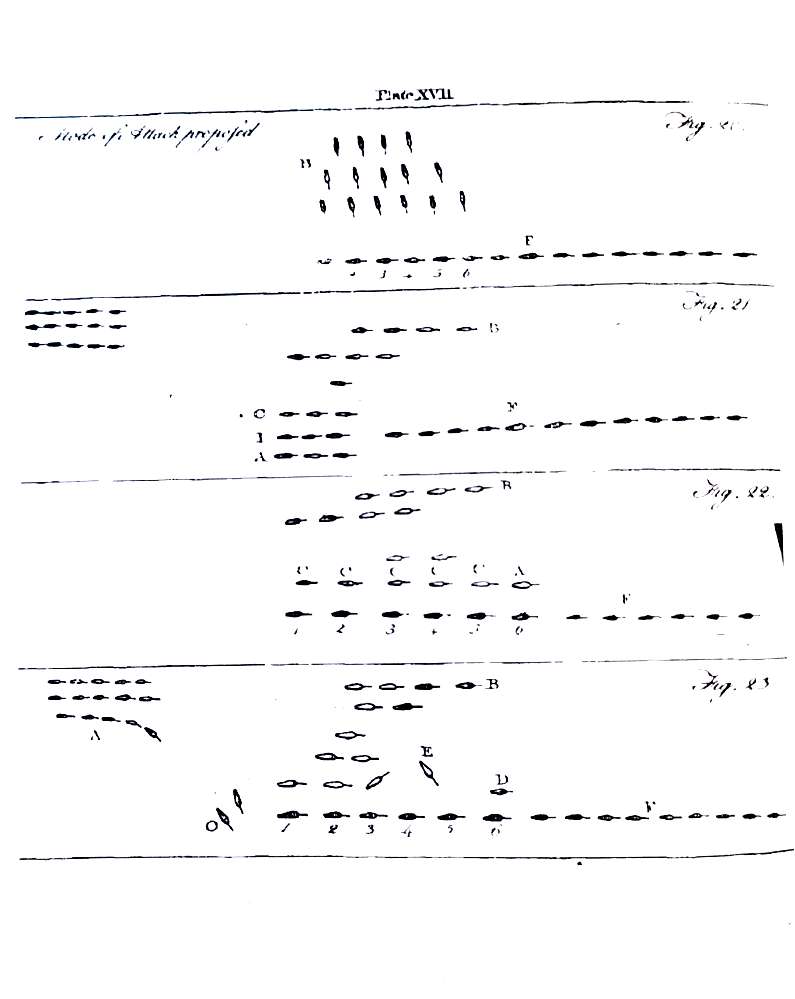
Caption
The questions surrounding Clerk’s influence on the Admiralty’s admirals have been ongoing ever since during Clerk’s lifetime. Much has been written about it in great detail. A new publication, due out later this year (2026 – further information to follow) by Jim Tildesley, unequivocally confirms Clerk’s influences on major officers of the Admiralty, the information extracted from Clerk’s surviving notes and correspondence. This finally resolves the arguments surrounding Clerk’s contribution to naval engagements.
Clerk had begun writing his naval tactics in 1778, sharing his thoughts discreetly only with particularly close friends before sharing them with selected naval officers. Through John Atkinson, whose architect brothers were associates of Robert Adam, a number of sketches were passed to Admiral Rodney for his consideration. Significantly, the Clerk family still have the copy of the Naval Tactics annotated by Rodney.
An Inquiry into Naval Tactics was first published privately, in a limited edition of 50 copies, in 1782. It was first published commercially in 1790, with three other parts issued in 1797. A second edition of 1804, as noted above, contained all four parts in a single volume, with three further editions.
Last note….in James Saxon’s portrait of John Clerk of Eldin, Clerk sits before a curtain, with his left hand on one of the vessel diagrams, above which there is a view of a sea scene with British warships. Saxon (1772-c1819) was a Manchester portraitist who visited Edinburgh in 1805 and who painted the portrait, but the seascape with ships was executed by William Anderson (1757-1837), a Scottish artist who specialised in marine art. Could it just be a coincidence that this portrait, with such a strong emphasis on the Navy’s tactics, was painted in the same year as Trafalgar?
Recommended reading:
An Inquiry Into Naval Tactics. By John Clerk of Eldin, Esq; Edinburgh, January 1. 1782 Available as a digital reprint from Gale Research Inc: Eighteenth Century Collections Online – Print Series.
Jim Tildesley The Influence of the Theories of John Clerk of Eldin on British Fleet Tactics, 1782-1805, The Mariner’s Mirror, 106:2, pp162-174. https://doi.org/10.1080/00253359.2020.1736397
Michael Romero Clerk of Eldin and the Royal Navy’s Offensive Line, Colonial Williamsburg Foundation, The Saber and Scroll Journal, Volume 10, Number 2. pp81-94. Winter 2021. https://doi.org/10.18278/sshj.10.2.7
CLERK OF ELDIN AND SHIPS
Following the quote from the preface to the second edition of An Essay on Naval Tactics (1804) cited above, John Clerk of Eldin continued:
After this apprenticeship, I had frequent opportunities of seeing and examine ships at the neighbouring port of Leith, which increased my passion for the subject; and I was soon in possession of a number of other models, some of them of my own constructing, which I often sailed on a piece of water of some size in my father’s pleasure grounds, where there was also a boat with sails, which furnished me with much employment. Besides this, I had studied Robinson Crusoe and read a number of voyages.
Three observations:
- Clerk was a constant visitor to the port of Leith, meeting and talking to seamen and naval officers based there, which gave him a deep understanding of ships and seafaring. (At one point in the 1790s, he tried to attain, without success, the Comptrollership of the port.) There are three etchings of Leith – Leith from the West (B58); Old Tower at Leith I (B87); Old Tower at Leith II (B88) – that include ships, and he was wont to add ships into his views where appropriate, as one can see by looking through the Clerk etchings gallery – note Cambuskenneth Abbey and Stirling (B52), North Queensferry (B59) and Perth Bridge (B65) for instance.
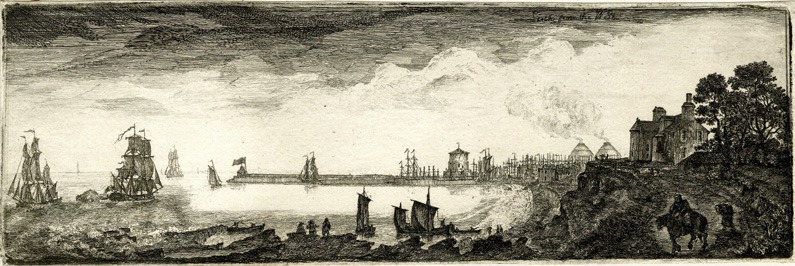
Caption
- Clerk was to combine his business activities with his interest in ships. In 1762, he had acquired a half share in the Pendreich coalfields, near Stirling. The coal business was one of the foundations of the Clerk family’s wealth – they owned land from Berwickshire to Lanarkshire and operated coal mines. However, Clerk took as great an interest in the by-products of coal as in its use as a fuel. As a shareholder in the Carron Company, an ironworks near Falkirk that had started operating in 1759 and that had opted to employ coke rather than charcoal for its furnaces, Clerk developed new and improved pitch sealants for use on the underside of ships, using the coal tar residue resulting from the foundry’s manufacture of the coke. It would be fair to assume that Clerks’ new sealants came out of the complaints of leaking hulls heard from Leith’s seafarers.
Caption
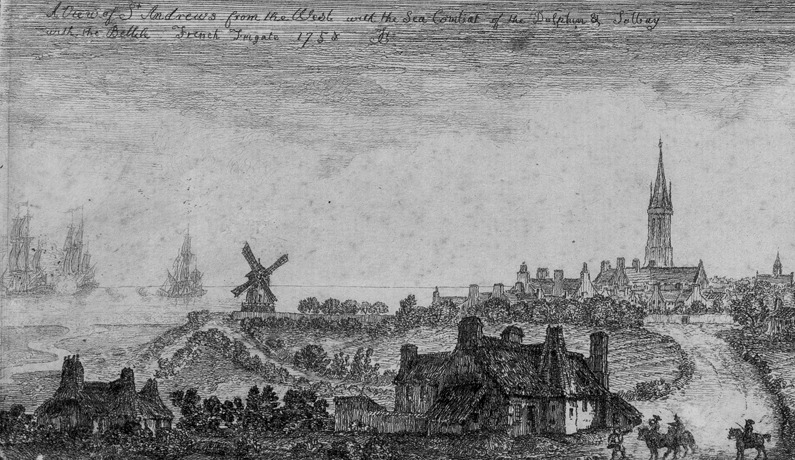
- One unusual and unique inclusion in a Clerk etching is the naval battle described in St Andrews from the West (B57). Within the plate, in the top left section of the sky, Clerk wrote A view of St Andrews from the west with the sea combat of the Dolphin and Solebay with the Belleisle French Frigate 1758, a statement which he expanded in the volume of etchings he presented to George III in 1786 where he stated it as The Town of St Andrews from the west. The combat between the Solebay and Dolphin, British frigates, and the Belleisle, a French Frigate of 44 guns commanded by Monr Thurot, was so near land that many of the shot came on shore on the Links to the left. The accuracy of Clerk’s statement has been extensively examined by Peter Lewis, a past director of the R&A British Golf Museum and historian to the R&A, St Andrews. His article was published in three parts in issues of The British Golf Collectors Society magazine Through the Green (March, June and September 2012; the article titled Uncertainties and Contradictions), and I would recommend his research to anyone wanting the complete story. What is worth establishing here is that the precise location of the engagement is open to debate, and that Clerk’s description, and that he added the combat to this view, is likely based on conversations and hearsay picked up on visits to Leith, where both the Solebay and Dolphin are known to have ported. The two British captains, Benjamin Marlow and Robert Craig, were well known through news stories, as was the French commander Francois Thurot, who had a reputation in Britain as a gallant enemy, regarded as having died a heroic death in his final encounter with British vessels off the coast of Carriefergus in February 1760. At the time that Clerk etched his view of St Andrews in 1775, the Dolphin was well known for having completed two global navigations, both in record times, in 1767 and 1768. It is unlikely that Clerk’s mention of the sea combat outside St Andrews is coincidental, while it adds special interest to the view.