
My previous Collecting Prints posts have been about my Old Master prints. However, on looking through the collection of art from my gallery background I see I have been buying modern and contemporary prints for a very long time. There was also the exhibition ‘Modern & Contemporary British Prints’ I organised in Taunton in 2014 which included examples of Henry Moore, Barbara Rae, Alan Davie, Bruce McLean, Anthony Gross, Alistair Grant, to name but a few. But I could say that my enthusiasm for prints goes back much further, to my first real job in the art world when I managed the print department of Aitken Dott & Son in Edinburgh (now known as The Scottish Gallery) which had an extensive stock of antique and contemporary prints.
A few years ago I decided to acquire some contemporary landscape etchings, to be a counterpoint to the Old Master collection. However, prior to that, my first purchase had been made in 2010 with a very fine proof, and very rare, etching by D.Y.Cameron – Rowallan’s Towers (1893) – which I proposed in my book on the etchings of John Clerk of Eldin as an example of the Romanticised castle image which, in my opinion, had been anticipated in some of Clerk’s castle prints of a century earlier. There is a distinct affinity between the two artists despite the considerable difference in years that divides them and their own artistic intentions. More recently I bought a second, earlier, example of Cameron’s work – Arran (1889). This is more of a seascape than landscape but it has all of Cameron’s hallmarks in movement, atmosphere and sense of distance.
I was not looking for contemporary prints that echo those of the Old Masters. Nonetheless, I find that Christopher Roantree’s Hunter’s Moon has a striking parallel in Salomon Gessner’s Leda of 1770. I do not suggest that they have anything in common other than that they feature a thoughtful looking, seated, naked woman that is centrally placed in the image. Both prints have birds and some dramatic lighting too, but I thought that, although coincidental, Roantree’s print was an unconscious re-imagining of a C18 Romantic idyll.
I unexpectedly found a very appealing etching by Hermine David – Près de Portsmouth. David (1886-1970), a French artist, was for a few years married to Jules Pascin, both members of the Ecole de Paris before WW1. When this etching was done is unconfirmed but seems most likely to have been during the 1930s when she had representation in London. I like her variety of line and her use of tone which animate the image. One can see from this plate why her work was so popular with critics and collectors.
I was privileged to know Lino Mannocci (1945-2021) when he was represented in London by Art First. It was at this time I acquired Dusk (1993). This is an imaginary landscape with a dreamlike quality. Clouds, a favourite and well studied subject of his, catch the rays of the setting sun which is disappearing at the end of a valley. The organisation of the sun’s reflection in the clouds creates a circular motion that takes the eye up either side of the valley and leads, via the angle of light, to its opposite side. A sole standing figure observes. It is possibly inspired by the landscape seen from his studio in Montigiano in Italy, where he would visit annually (he was born in Viareggio and moved to London in 1968 which became his primary residence). Besides being an excellent etcher, Mannocci was a world authority on the etchings of Claude Lorrain – his catalogue raisonné on Claude’s prints remains an essential reference book.
London born, Sheila Onliner (1930 – 2020) moved to Cornwall in 1985, opening a studio in St Ives. In London, she had trained at Slade School of Fine Art in 1945, and then City and Guilds. In the 1970’s she worked at Studio Prints, where she learnt print making from Dorothea Wight. She was an active participant in the St Ives printmaking scene. Zennor Night is an aquatint inspired by the village where she lived, the moon formed by a burnished piece of gold leaf. It is a contemplative image, its zen quality one of the reasons why her work was particularly well-admired in Japan. Like Mannocci’s print, it is very much a landscape of the mind.
Although born in England Jenny Graham spent much of her formative years in the US. She first studied art at the Cooper Union Art School in New York City before returning to the UK. She has been based in Somerset for the past three decades. A versatile and imaginative artist she has experimented extensively with photo-etching, among other print techniques. Aller Moor on the Somerset Levels is a double-plated print in which she gives the illusion of the sky in the lower half feeling as if it’s a continuation of the foreground pond in the top. It’s not a mirror image or a reflection. One of the things I admire about this print is that it challenges the way landscape can be re-imagined.
The etchings by Seow Wai and Lucy Ward are contrasting images, the former being lightly drawn and etched, the latter being an aquatint with strong tone. Wai’s view of a distant city, A Mellow Hillside, employs a long-time tradition of framing the scene with trees and a foreground that drops away before the viewer (both inside and from outside of the print!). A small rotonda monument anchors the foreground. His trees are done with a mix of line etching and tonal aquatint which become fainter as they recede. The city, caught in slanting light, is dominated by a cathedral, the lines of the spires of other churches leading the eye towards it. In its construction, Wai’s image contains elements of a much older tradition in landscape art.
By contrast Lucy Ward’s foreshore view Towards the Forest is a bold statement with the cliff dominating the image. It stands proudly on the foreshore trees and mist behind. It has an mysterious atmosphere which is built up by the variety of shades of grey and dark tones that contrast the misty air to its left.
In a change of policy, some of the prints mentioned here are offered for sale. Each is linked to the Artworks page via their titles where further information is provided.
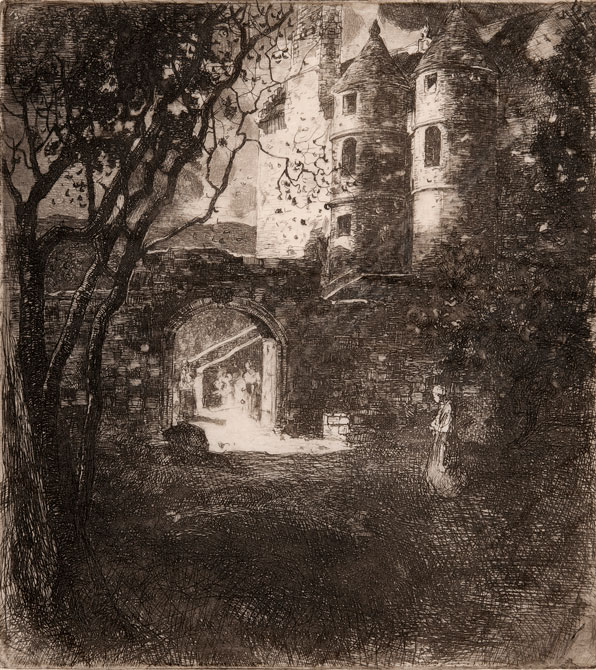
D.Y. Cameron ‘Rowallan’s Towers’ 1893 Collection Geoffrey Bertram
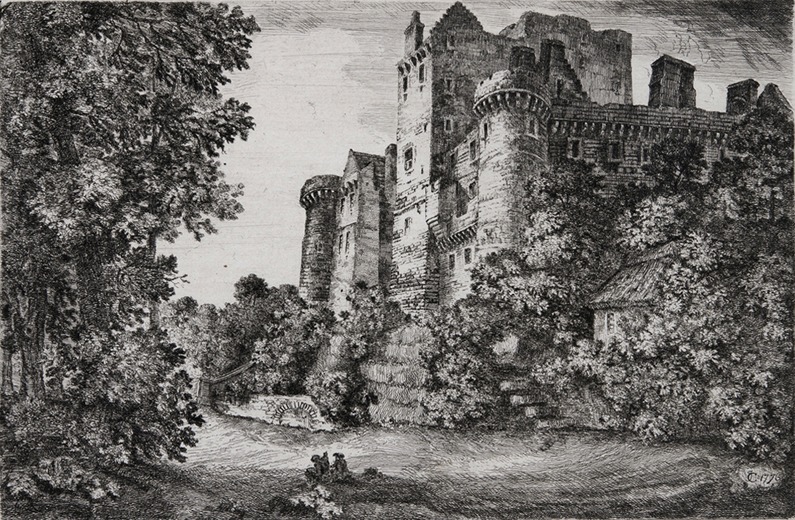
John Clerk of Eldin ‘Craigmillar Castle from the South East’ 1777 Collection Geoffrey Bertram
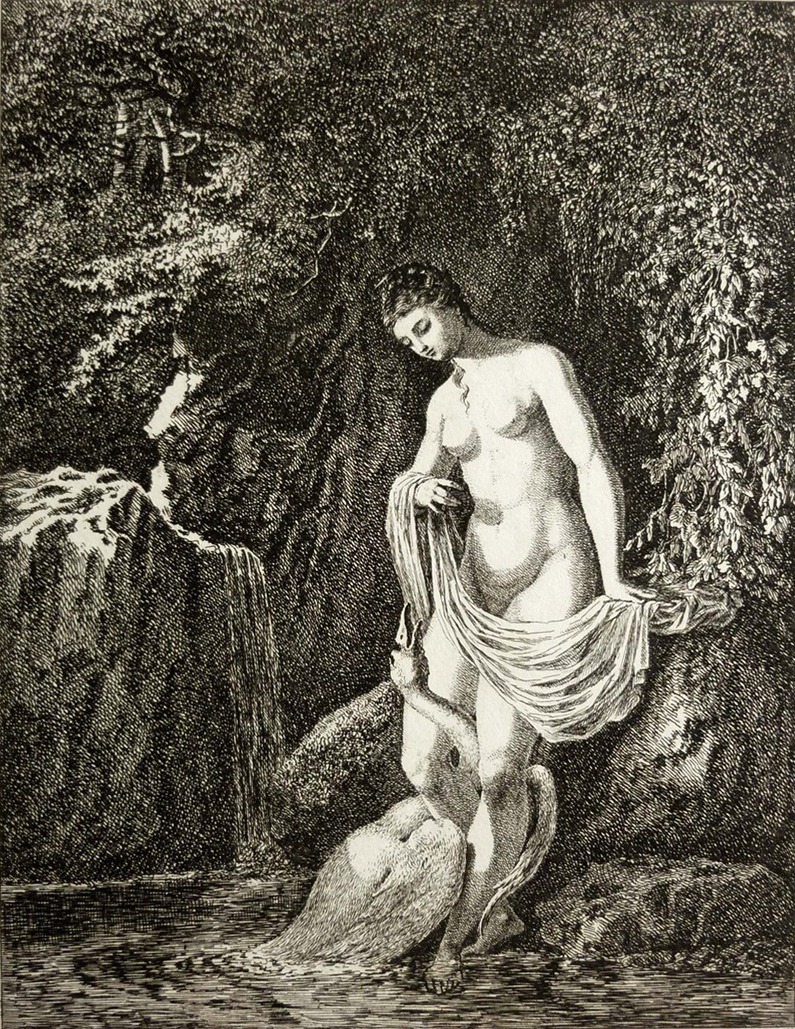
Salomon Gessner ‘Leda’ 1770 Collection Geoffrey Bertram
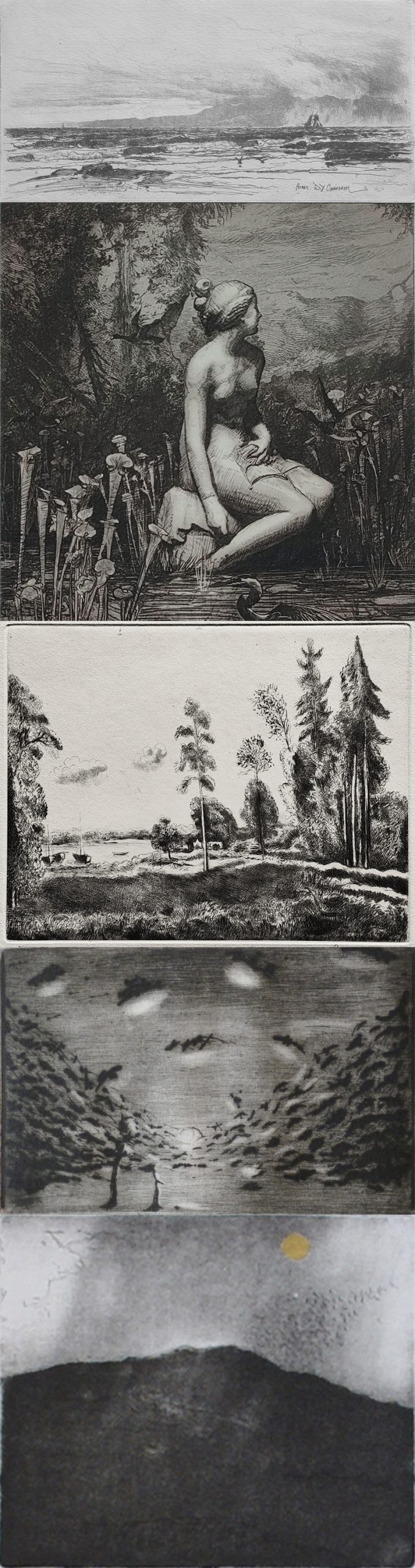
From top: Cameron, Roantree, David, Mannocci, Onliner
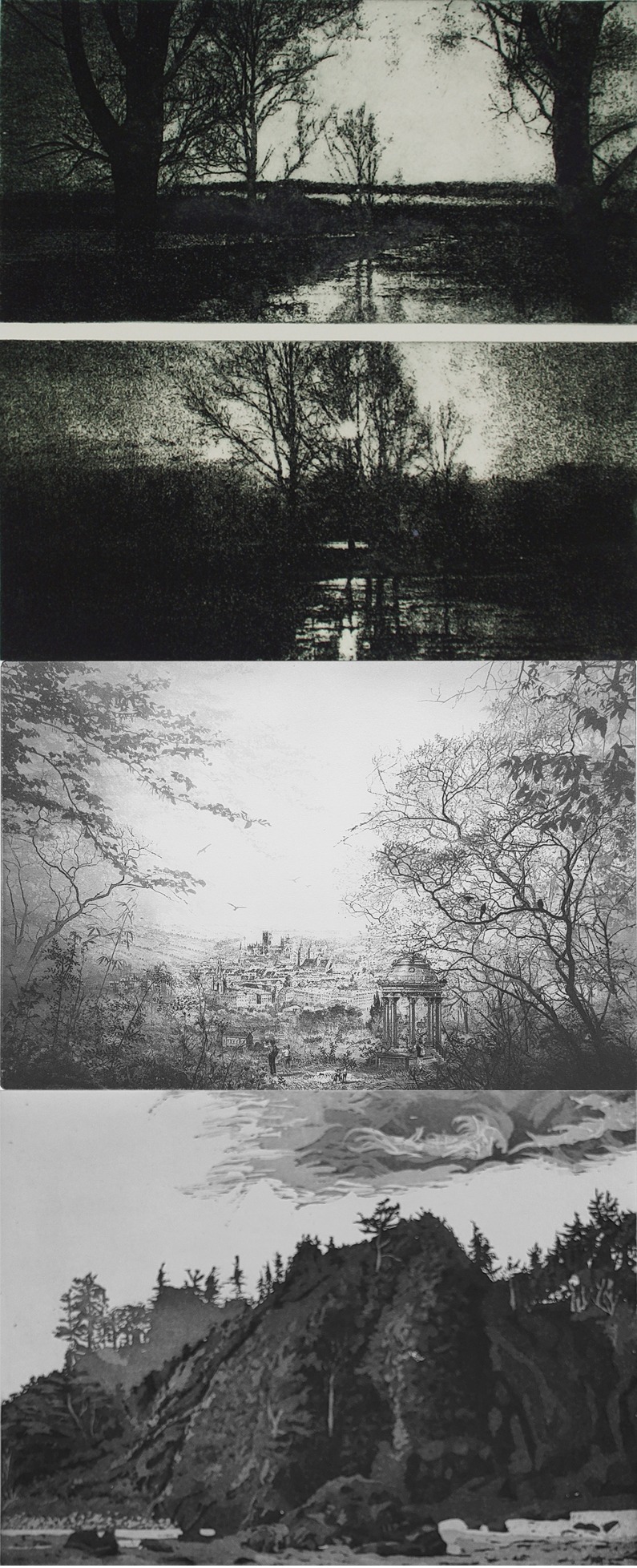
From top: Graham, Wai, Ward