
I introduced my interest in old master prints in a previous article. Since then the collection has grown even further and has arrived at a point where it requires a modest rationalisation. The prints I am de-accessioning can be found in the Old Master Prints Gallery.
Over the past couple of years I have been continuing to research my prints. Doing this is rewarding and I am reminded daily of the wonderful opportunities that collecting brings to broadening the mind. Sitting as I am away from any major urban area and working with limited funds, there is a far greater wealth of material to access than I would ever have thought possible fifteen years ago when gearing up to celebrate John Clerk of Eldin’s bicentenary in 2012. There is a huge amount of information on the internet to use as a starting point although one needs to be careful about the accuracy of information found there. Always double-check the sources. Acquiring relevant art books, if you can find them, is also important. I have built up a small library of essential publications, but I should add that top quality art books can be more expensive than the prints!
I would encourage anyone to dip their toe in the print market. If this sounds attractive, I can offer some advice, the first being that it is best if you decide beforehand what it is that interests you. The print market is huge and varied, from playing cards and broadsheets to comics, caricatures and contemporary art. I elected for Old Master prints arising from my time with John Clerk of Eldin whose landscapes I found inspiring, as I still do. Even within the topic of landscape there are different genres to explore, from the work of important artists to reproductive engravings to exacting topography and nature studies. The world really is one’s oyster in this regard.
The subject of landscape underpins the illuminating exhibition Turner and Constable – Rivals and Originals currently on at Tate Britain, London (until 12 April). The exhibition marks the 250th year of their births. Both artists strived to improve landscape art but went about it in very different ways. It is hard to get a proper understanding on this through looking at their prints. John Constable was not a printmaker, the most important prints of his work being the mezzotints by David Lucas with whom he collaborated. J.M.W. Turner was more hands on. His Liber Studiorum, a book of his designs that was inspired by Claude Lorrain’s Liber Veritatis, was made up of seventy one plates for which Turner completed all the soft ground etching outlines, though the toning was produced using aquatint or mezzotint executed by third parties. Lucas’s Constable prints lie outside the parameters of my print collection but I have a couple of fine examples by Turner – Woman with Tambourine and Dumbarton. Turner’s Woman with Tambourine reflects his love of and appreciation for the work of Claude Lorrain. The image is a fine representation of the area around Tivoli, a part of Italy that has attracted and engrossed artists since the sixteenth century. Constable’s visions were more down to earth and introduced a new realist aesthetic to British landscape painting, that looked away from classicism and to a greater grounding in the human experience. In his early years he had taken an interest in Claude (Claude’s influence on C18 English landscape art was overwhelming) but he moved away from it in his maturer years, signalling a different direction for C19 artists. Given the direction of my print collection (it ceases in 1820) this was a pathway I was reluctant to walk down. But, I would like to point out, this is yet another example of the diversity of landscape art, both in the art itself and in conversation about it, and the choices one makes as a collector.
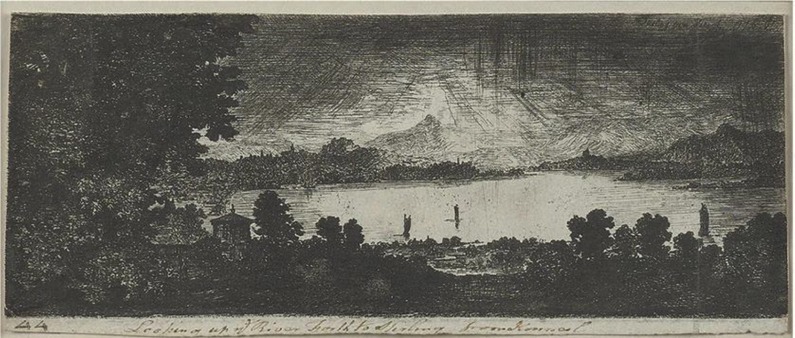
John Clerk of Eldin ‘Stirling from Kinneil’ 1776 etching 7.9 x 20.5 cm. Collection Geoffrey Bertram
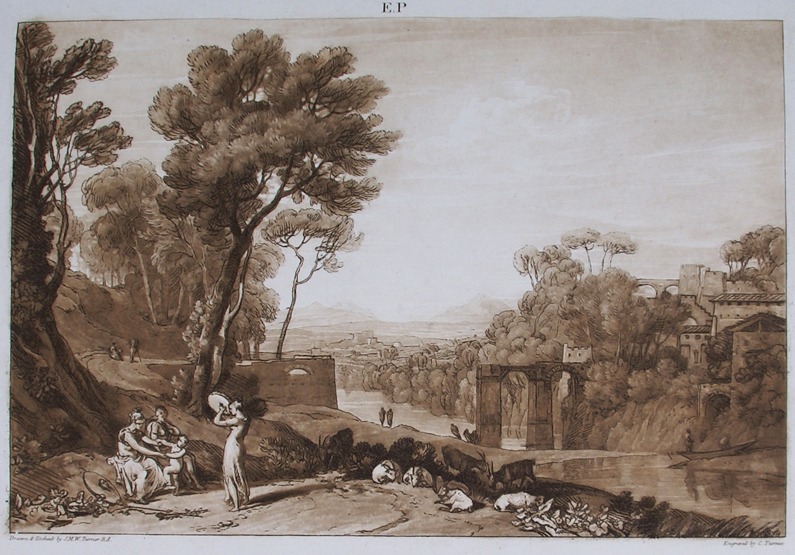
J.M.W. Turner ‘Woman with Tambourine’ 1807 soft ground etching with mezzotint 20.8 x 29 cm. Collection Geoffrey Bertram
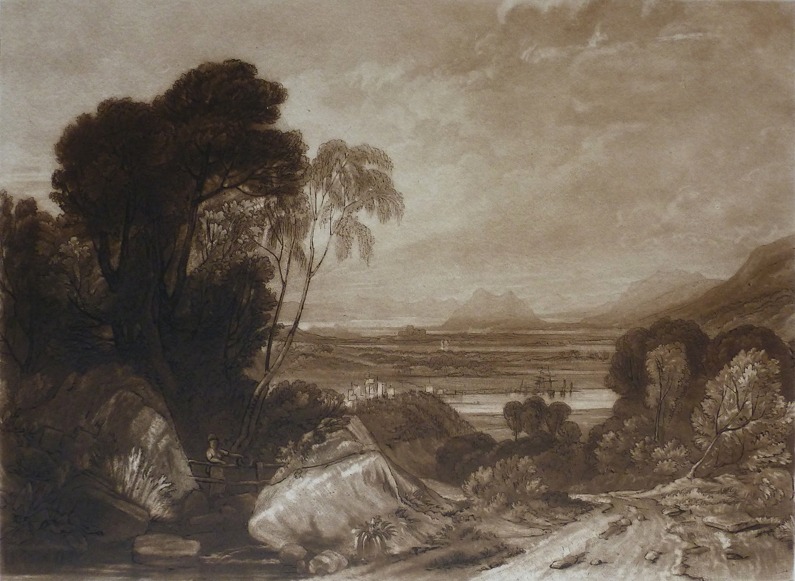
J.M.W. Turner ‘Dumbarton’ c1819 soft ground etching with mezzotint 22.2 x 28.7 cm. Collection Geoffrey Bertram