I first encountered Paul Sandby (1731-1809) as a friend of John Clerk of Eldin (1728-1812), the amateur Scottish etcher. The two men had met in 1747 when Sandby, at the young age of sixteen, travelled to Scotland to take up a position to work as ‘the chief draftsman of the fair Plan’, an official Military Survey of the Highlands undertaken by the army’s Board of Ordnance on the order of William Augustus, Duke of Cumberland, following the 1745 Jacobite Rebellion. Sandby’s post was likely secured by his older brother Thomas who was part of Cumberland’s retinue. The Board’s office was in Edinburgh Castle.
Part of Cumberland’s clampdown on the Highlands was the construction of Fort St George at Ardersier, to the north east of Inverness. The contract was in the hands of William Adam, architect, builder and entrepreneur, who had been appointed chief mason to the Board of Ordnance in 1745. One of his private clients was Sir John Clerk of Penicuik, John Clerk of Eldin’s father. The Clerk family were regular visitors to the Adam’s home in Edinburgh’s Cowgate, son John becoming a close friend to William Adam’s son Robert. Young John was to become part of the same family when he married Robert’s younger sister Susannah in 1753.
Paul Sandby was also a regular visitor to the Adam family home in Edinburgh through this Board of Ordnance connection. It is known that the three men, Paul, Robert and John would go out drawing together. John’s father had emphasised the importance of drawing and design as “…the best means of advancing their fortunes , for they can neither be good sojars nor first seamen if they know not how to design a Country, a Town, a House, and especially a fortified Town or Castle” John and Robert’s drawing ability was fair but Paul was in a league of his own, which accounts for his important position at such a young age. He was three years younger than both John and Robert but had a natural aptitude for drawing.
When Paul returned south in 1751 Clerk and he maintained their friendship albeit at a distance. Clerk was a great admirer of Sandby, owning “about thirty” of his works. Unfortunately there is little surviving correspondence between the two, the most significant being a couple of letters regarding the methods of soft ground etching and aquatint. It is known that Sandby encouraged Clerk to take up etching, which he did for a short period of years between 1770 and 1778, and gave him instruction in soft ground etching.
Sandby is often viewed as a topographic artist, though this dismissive description takes no account of his creativity. Topography was, and in the main still is, considered as a precise and recognisable record of places. It was in much demand from eighteenth century British publishers. Landscape art, on the other hand, is the imaginative manipulation of natural features into a composition that is aesthetically pleasing or otherwise impressive. The distinction is one of aim and in theory it is sharply defined. In practice, however, it is not always so easy to make the distinction as both elements may exist in the same artist. Sandby is a case in point, as even in is most topographic work he showed an eye for the picturesque.
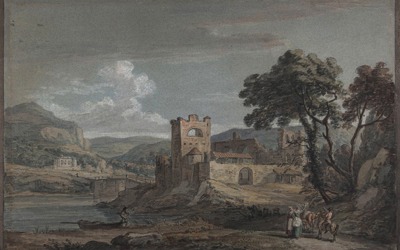
A good example of Sandby’s wholly imagined landscapes is the watercolour Capriccio Landscape. Painted in 1779 it depicts an Italian style landscape with a partly ruined walled villa and ruined aqueduct behind. Beyond that is a river crossed by a wood bridge, set within a mountainous landscape that has the appearance of the Italian Campagna. It is a complete fantasy but it has an authentic feeling even though he had never visited Italy. Sandby had been making prints in an Italian (and Dutch) manner since the late 1740s when he made several etchings based on drawing books, manuals that were educational aids for aspiring artists. These instruction booklets included landscapes in Dutch and Italian styles. Capriccio Landscape features many of the elements found those studies.
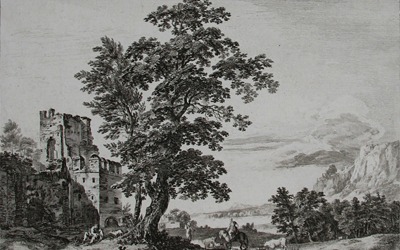
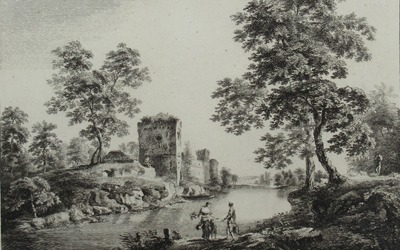
Sandby had some form of grounding in etching before he arrived in Scotland. His first set of Scottish landscapes were etched in 1750, with two following sets in 1751. The earliest etching in my collection is Landscape with Ruined Castle of 1758. It might be assumed that this was a Scottish scene though the other four in this group of horizontal landscapes are not, two certainly being inspired by Dutch artists.
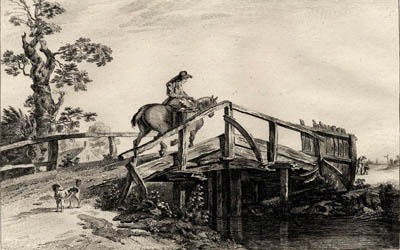
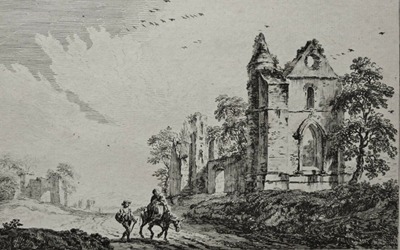
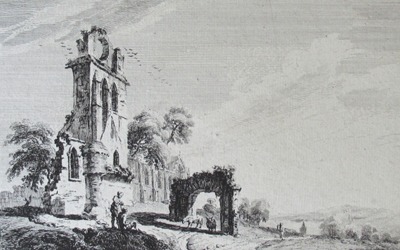
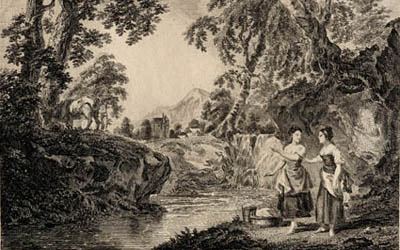
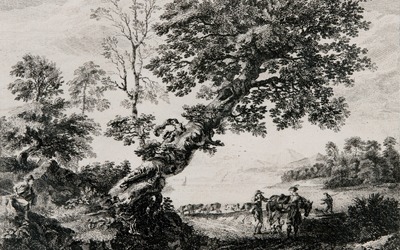
The year 1758 was a productive one. Crossing the Bridge is one of ten Landscapes with Figures. This print reminds me very much of Adrian van Ostade’s The Angler (1647-53). Ruined Abbey with Travellers on the Road and Ruined Abbey, from Six Ruins, appear to be based on Arbroath Abbey. Both are handled in similar manner to the way Rome’s ancient ruins were portrayed. Peggy and Jenny is the third of five plates illustrating Allan Ramsay’s The Gentle Shepherd. The tower house with its cylindrical turret in the background provides the Scottish context. Coastal Scene – a horseman and shepherd conversing and River Landscape with Figures are part of six Landscapes with Trees. Neither can be recognised for any specific location though the first could be Scottish in looking at the costume of one of the standing figures.
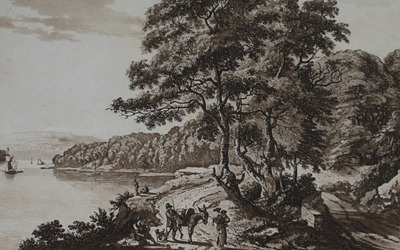
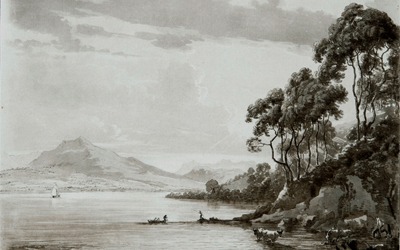
The grouping of these prints from 1758 was established by the publishers Ryland and Bryer of London when they issued “One hundred etchings, by the ingenious Mr. Paul Sandby….” in June 1765. Ann Gunn’s thorough catalogue raisonné of Sandby’s prints lists over 180 etchings up to this time. However, for many, Sandby is best known for his series of aquatints. These are represented in my collection by View up Neath River from the House at Briton Ferry in Glamorgan Shire from Twelve Views in South Wales (1775) and Pimble Meer from Twelve Views in Wales of 1777. Aquatint was a new etching technique, a tonal method developed to simulate watercolour wash in print form. Sandby was the first British artist to use it. On seeing Clerk of Eldin’s attempts to achieve tone in his prints Sandby declared “I perceive you have been trying at [Jean Baptiste] Le Prince’s secret, know my good Friend I got a key to it and am perfect master of it…”
View up Neath River and Pimble Meer are of course more clearly topographical by being of specific places. Nonetheless, in Sandby’s selection of viewpoint, manner of lighting and arrangement of composition, one could just as easily see them as Welsh versions of the Roman Campagna, echoing the prints of the seventeenth century Dutch etcher Jan Both. In these two prints Sandby used soft ground etching before adding the tone. His accomplished use of aquatint is very effective in giving the views a fuller range of tones than could be achieved by the drawn mark. Aquatint became very popular very quickly. For toning It was widely used in the late eighteenth and early nineteenth centuries as an alternative to mezzotint. The etchings JMW Turner’s made for his Liber Studiorum comprise soft ground etching in his hand and, separately, aquatint or mezzotint was added by others. A very fine example is Dumbarton, available here.
All prints and watercolour from collection of Geoffrey Bertram. Titles in bold available for purchase.
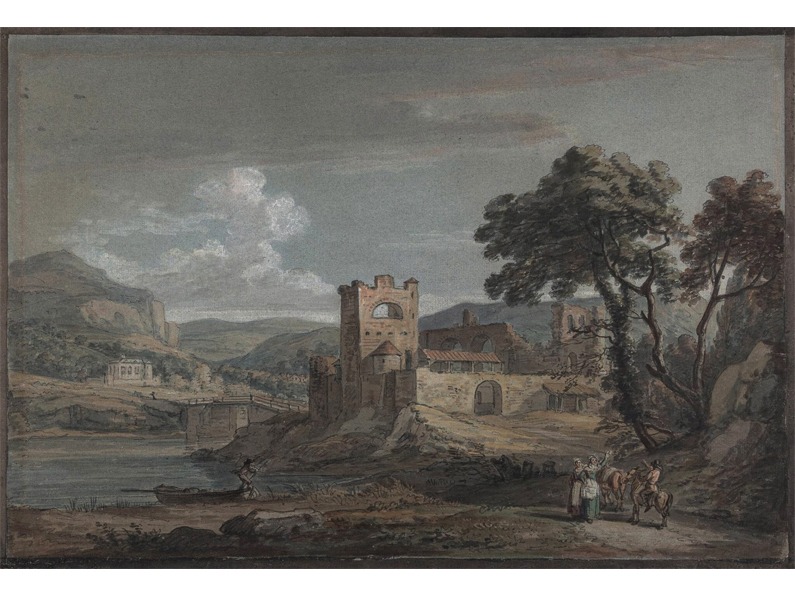
Paul Sandby Capriccio Landscape 1779